Earlier this month I posted a sneak peak of my awesome Paradise Helicopters Tour from Ka’u to Hilo (I say awesome again, though I banned myself from describing anything with that word because I said it too often during our flight). As promised, here is a more detailed look into the hour-long tour.
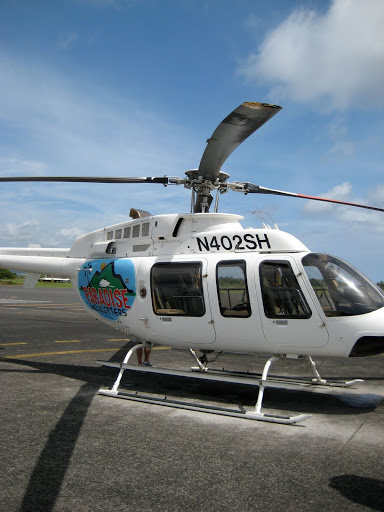
I boarded the ‘copter at the new Ka’u Coffee Mill. The visibility was poor that day because of rain and that dreaded word that rhymes with dog, but luckily it cleared up, just for us.

After we strapped on our safety packs and Paradise President Cal Dorn led us through a pre-flight safety brief, we were on our way. I and my fellow passengers donned our miked headsets, which muted the noise and allowed Cal to very naturally explain what we were seeing. I could also speak to Cal through my microphone as well as to my fellow passengers which made for a fun and naturally interactive tour.
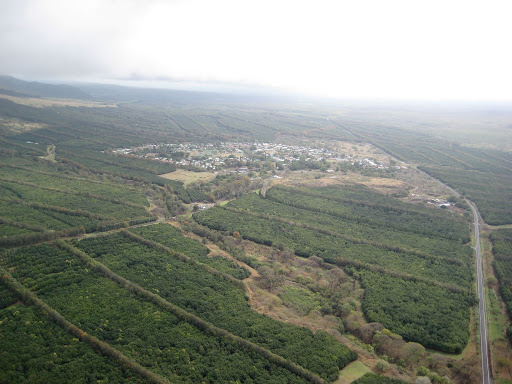
First we cruised over the Ka’u coffee and macadamia nut farms, viewed the fast-growing commercial eucalyptus forest, and then had a rare glimpse of Pahala town, surrounded by macadamias.
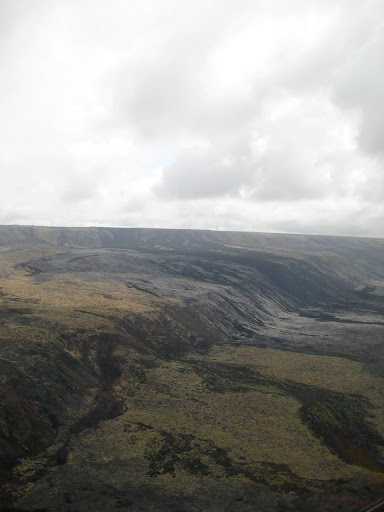
Then we were off to the lava, an experience which transformed me into a helicopter tour believer. Never before had I seen the transition from old to new land in such a sweeping way, clearly viewing old and new flows that once poured into the sea and shaped this portion of the Big Island.
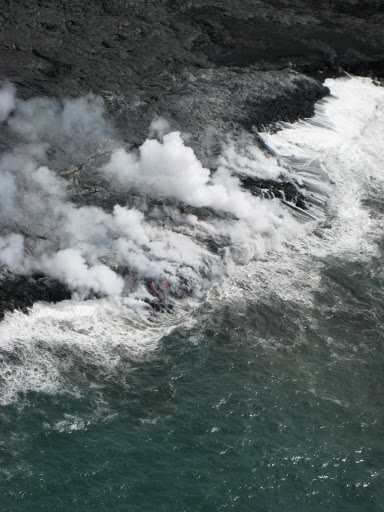
Just a few days earlier, on April 30, lava was reportedly flowing into the sea at Kalapana, and from a distance you could witness the steam rising in a plume and heading mauka as if it were a beacon. As we flew closer, through crashing waves a crimson glow could be glimpsed (better with the eyes than with a camera shutter), and a shelf of black lava pounded by fire and water rested beneath us. It was simply captivating.
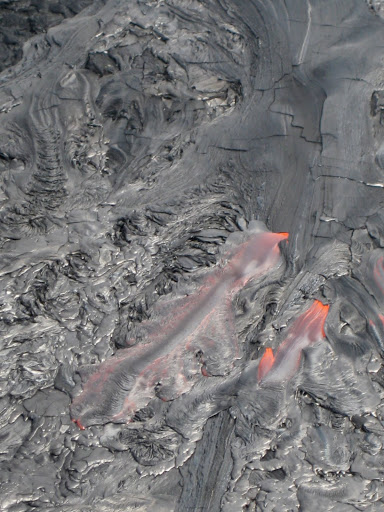
The charred land and aquamarine sea were enmeshed with ivory steam; the surrounding land lay quiet, burning in silence underneath. As we flew toward Hilo we luckily caught a burst of molten lava as it began pouring onto a silvery lake of recent flows (that was in my sneak peak). Had Cal not been there at that time, we’d never have known it had just happened.
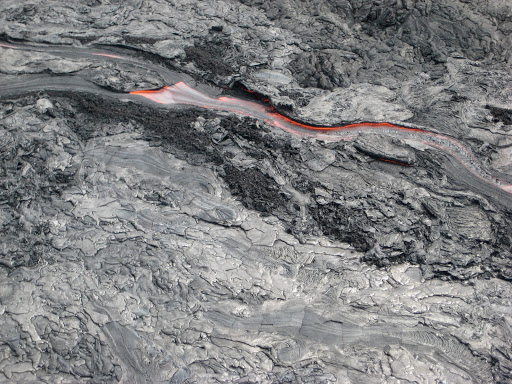
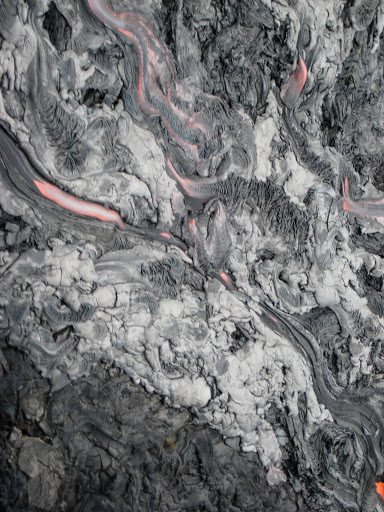
We scouted the area looking for more bursts, and I was able to capture these smoldering veins as we inhaled the sulfur and felt the heat for a few seconds more.
Soon the lava “gave way” to green as we crossed over the Hilo rainforest. I had no inkling of how broad its reach, and how avocado green its canopy.
An hour passed in a blink, and we arrived at Hilo airport with a seamless landing. Having flown planes as a teenager, I was dying to get into the cockpit, which the kind Cal allowed me to do–just for a moment. And then I was off to my next adventure–a volcano park tour guided by the humble and knowledgeable Warren Costa of Native Guide. But I made a promise to myself to get up in the air again as soon as I could–preferably with Cal as my pilot.
Addressed to Toru Okada, the protagonist of Haruki Murakami’s amazing novel, THE WIND UP BIRD CHRONICLE.
Stereotyping Readers by their Favorite Hawai’i Author (or mainland author who has written about Hawai’i)
When I first read Lauren Leto’s deliciously evil list stereotyping readers by their favorite authors, I thought “someone should do this for Hawai’i.” Then, in a Twitter post, the lively and lovely Dawn from Honolulu’s Watermark Publishing nominated me to do just that, knowing nothing of my own thoughts. Duly encouraged, here I am a few months later with a list of my own.
Some will think this endeavor some measure of funny, boring, evil, unnecessary, silly and [fill in the blank]. But I had a lot of fun and laughed a lot while alone in my office brainstorming and compiling. And in the end, I managed to comprise a surprisingly long, stellar list of 50 Hawaii connected authors, and that’s not bad at all. (I apologize in advance if I’ve left anyone out–I merely listed everyone I could think of off the top of my head, and asked for recommendations on Twitter and LL and voila.)
Here they are in no particular order. Feel free to add to the list in the comments and forward the link. It’s all in good fun.
Ian MacMillan
People from the mainland who’ve lived here “for more than twenty years.”
Chris McKinney
Disgruntled West O’ahu suburbanites
Allegra Goodman
Expatriate kama’aina living in NYC
Susanna Moore
Missionary descendents
Lois Ann Yamanaka
Pidgin connoisseurs
Mark Twain
People who lie about books they’ve read
Jack London
Men who work in cubicles
Robert Louis Stevenson
Men with mustaches and canes
Lee Cataluna
Folks you meet at Long’s (duh)
Eric Paul Shaffer
Guys born in the ‘70s who wish they came of age in the ‘60s
John Clark
Lifeguards, surfers and beachcombers
Mia King
Fierce 40-year-old women who are so over lunching
Jane Porter
Women who wish their husbands were better in bed
Wayne Moniz
People who think Maui No Ka Oi
Gavan Daws
Media haters
Paul Theroux
Guys who frequent Waikiki dive bars
Jon Van Dyke
Akaka Bill supporters
Maxine Hong Kingston
Women in Lua training
Kaui Hart Hemmings
Punahou graduates (too easy)
Patricia Wood
Residents who want gambling legalized
Haruki Murakami (re Blind Woman, Sleeping Willow)
English majors who love jazz
Stuart Coleman
People who have a timeshare in Kihei
Kiana Davenport
Women who lie about having a timeshare
Billy Bergin
Cowboys (too easy)
Barack Obama
People who believe he was born in Honolulu
James D. Houston (re Bird of Another Heaven)
Historical conspiracy theorists
Martha Beckwith
People who don’t take pork over the Pali
O.A. Bushnell
English teachers
Randy Roth
People whose kids can’t go to Kamehameha
Derek Bickerton
Profs who idolize Jane Goodall
Wayne Westlake
Slam poets (too easy)
Robert Barclay
Marshall Islanders
Susan Schultz
Girls who keep their journals locked and hidden
Nora Okja Keller
Foxy girls (too easy)
Arthur Rath
Stealth Hawaiians (and Menehune)
Richard Hamasaki
Boys who argue with English teachers about Hemingway
Gary Pak
People who won’t admit they watch Korean Soaps
Victoria Nalani Kneubuhl
Women without enough drama in their lives
Isabella Bird
Women who volunteer at historical societies
David Mitchell (re Cloud Atlas)
Journalists and writers
W.S. Merwin (re The Folding Cliffs)
Guys proving their sensitivity to their girlfriends
Lisa Lynn Kanae
Canoe paddlers
Alan Brennert (re Moloka’i, Honolulu)
City dwellers
Joan Didion
Magical thinkers
Haunani Kay Trask
Sovereigntists
Bret Easton Ellis (re The Informers)
People whose heyday was in the ‘80s
John Dominis Holt
Hapa-haole Hawaiian art and culture experts
John Saul
Teenagers
Mary Kawena Pukui
Translators
Kathleen Tyau
Kama’aina living on the other side of the Pacific
Photo by CT
REVIEWED BY CHRISTINE THOMASDepending on your position, childbearing is a stupendous miracle, a persistent hell or “an exercise in optimism” — and at times all and more at once. But in Orange Prize-winning British author Joanna Kavenna’s new novel, women’s eternal predicament (and ensuing issues of parenting and being parented) anchors a slick, ambitious narrative deftly entwined with life’s other complex balancing act: keeping hold of reason and sanity.
The four-part narrative is never mawkish, shifting from past to present to future and back with steady prose and a meticulous design that leaves neither the subtle nor symbolic to chance. Each distinct yet inherently connected section begins on Aug. 15, either in 1865, 2009 or 2156, and is titled after major Tarot cards symbolizing human nature. First is The Moon, representing fear and peril-perfect imagery in an anxious and circuitous letter from insanity scholar Robert von Lucius to an unnamed professor. Lucius begs for insight into interviews with an anonymous patient at Vienna’s Public Asylum, mirroring the true history of Hungarian physician Ignaz Semmelweis, called the “savior of mothers.”
Evoking Semmelweis’ attempt to halt rampant childbed fever helps Kavenna stoke momentum. The next “card” flipped is The Empress, symbolic of Mother Nature; this section is set in London in 2009, when proofreader Brigid Hayes is about to have her second child. Her sections are the most immediate and haunting, submersing readers in the tense see-saw of joy and fear, annoyance and delight accompanying pregnancy (she’s “entirely with child — her body had been colonized,”); parenting (she fears failing her son), and being parented (wishing her own mother would leave her be). Brigid’s eventual labor is so intimately described it imparts a tangible film of exhaustion and elation.
But Brigid is inevitably eclipsed by the neurotic, solitary Hermit Michael Stone, or the Fool born as a man. Michael is across London celebrating another sort of birth — the publication of his first novel. Michael is single and estranged from his family, and the attention makes him vulnerable and pushes him inward, testing the bounds of his sanity — and at times the reader’s patience. Discerning the shimmer of madness only gets more complicated with the unveiling of The Tower, symbolic of ruin, suffering and disaster. In this section, set in 2153 when the world is engaged in a so-called “war against nature” due to climate change and overpopulation, interview transcripts with Prisoner 730004 reveal a future in which women are incapable of giving birth, and questioning the status quo labels one as delusional.
From Kavenna’s protean novel emerges a brilliant whole. But just as Tarot readings inspire thinking about past, present and future paths, The Birth of Love is poised to reveal something inimitable to each individual. But first the characters must digest the meaning of the cards and determine their guidance for the future — which, as Michael articulates, is “the locale of your hope, the place where you deposit your expectations. And your fears, too.”
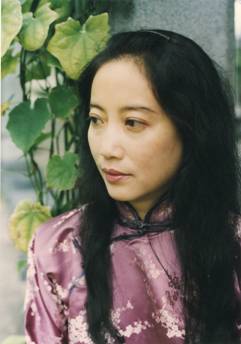
In 2008 I reviewed a peach-colored paperback original that had come across my desk by accident, which draws on the life of its author, novelist Mingmei Yip. Yip’s professional gambler father and artist mother dreamed she would become a scholar, and so Yip rose to the challenge, graduating from the Sorbonne, studying Chinese arts and the ancient qin musical instrument. After her first foray into writing—journaling during her mother’s eight-year absence while imprisoned in a Vietnamese camp—Yip became a writer, too. All of these life experiences are channeled into her engrossing debut novel “Peach Blossom Pavilion,” which brings to life the time of China’s mingji—artist-prostitutes who were geisha predecessors. {Read my review here}
Now she’s back with a new novel drawing from her life experience with Zen Buddhism. In “Petals from the Sky,” Meng Ning seeks to become an nun, even though in her thirties, but fateful circumstances lead her to question her life direction and to another path.
Though busy with her book tour, I corresponded with Ms. Yip recently about what she’s reading, and how karma has shaped her life.
Interview with novelist Mingmei Yip March-April 2010
by Christine Thomas
C.T. What are you reading these days?
M.Y. I just finished reading Chesley Sullenburger’s “Highest Duty” which I really enjoyed. I like to feel connected to people who really care what they do and do it well.
Now, I spend most of my time polishing my forthcoming third novel, “Song of the Silk Road,” a love story between a woman of twenty-nine and a younger man of twenty-one on the famously dangerous Silk Road. An adventurer, the young woman attracts danger as much as she does men—like bees to honey. C.T. What made you pick up Highest Duty?
M.Y. I like to learn new things and things that I find interesting but don’t know much about. I find anecdotes about planes and pilots in “Highest Duty” very engaging to read, especially those related to nice and brave people.
C.T. What is it about the anecdotes that specifically grab you?
M.Y. “Highest Duty” is Captain Sully’s life journey as a pilot—his training, various anecdotes of flying, his family, and of course the famous landing on the Hudson River. I was particularly moved by an incident of a World War II pilot who, trying to save seven of his fellow pilots’ lives, ended up seventy percent burned, underwent forty odd surgeries and was left blind. But he survived well into his ripe old age. I am reassured by the spirit of bravery and self-sacrifice of ordinary people. Since I like to write about strong and brave characters, this incident particularly struck a chord in me, though it is far from my own experience.
C.T. What experience have you drawn on to create strong and brave characters in your new, second novel, PETALS FROM THE SKY?
M.Y. Buddhist nuns—I befriended these extraordinary women in my youth and know them from the inside. These women are very brave and independent. Imagine leaving home at a young age, living in the unfamiliar environment of an esoteric temple, and giving up your chance for worldly pleasures including romantic love.
My mother and grandmother are also inspirations for my strong female characters, especially my grandmother, who successfully ran the Pepsi Cola factory in Vietnam after my grandfather unexpectedly died in his early fifties.
C.T. How did you come to befriend Buddhist nuns, and where were you during this time?
M.Y. In my early twenties while living in Hong Kong, I attended a social gathering where I heard a friend talk about Buddhism using esoteric terms like samsara, nirvana, and karma. Completely fascinated, I sought to understand all these strangely beautiful phrases by plunging into the study of Zen Buddhism.
It’s karma that a friend told me about a beautiful, talented nun who was running a temple not too far from where I lived. So I began to visit her whenever I had time and we became very good friends, exchanging ideas on arts, religion, and life.
It was many years before I came to understand what Buddhist philosophy is all about. So I’m very proud that I published a book on Zen Buddhism, which became a best seller in Hong Kong.
C.T. Did you model Yi Yong, the young nun in your new novel, after your mentor, and were you ever tempted to live life in the temple, just as your character Meng Ning wants to do?
M.Y. Yes, the young nun in “Petals from the Sky” was inspired by my nun friend of many years. During our frequent meetings, we talked about religion, arts, aesthetics, monastic life and the like. She always hinted that she’d like me to join her temple and I’d been tempted, albeit very briefly, before I met my future husband at a Buddhist conference in Taiwan. The strange working of karma.
C.T. What is karma leading you to next—another adventure in life, or in writing?
M.Y. I believe karma is now leading me to bigger projects both in my writing and music.
Mark Twain is an American icon.
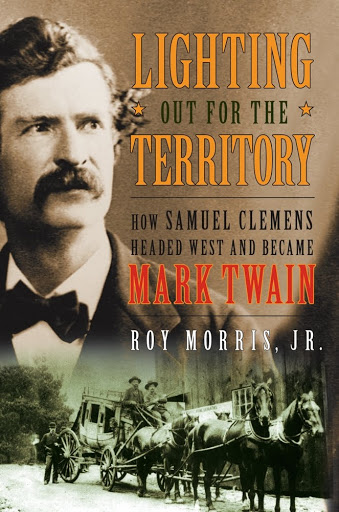
As historian Roy Morris Jr. says in his new book, Lighting Out for the Territory, Twain’s name “is as much a trademark, in its way, as Coke or McDonald’s, or Mickey Mouse. He’s that big.”
Known for his red, bushy hair, humor, and exaggerations—“he rarely let the facts get in the way of the story,” says Morris—Twain’s tall tales helped make Twain famous, and like the stories of his arguably equally famous character Huck Finn, are to be taken with a healthy dose of salt.
Even Roughing It, Twain’s personal account of his 1861 stagecoach trip from Missouri to the then Nevada Territory, at age twenty-five, and ensuing adventures in the American West, does not escape the “stretchers” he deemed necessary to a good story. And thus the aim of Morris’s book is to tell the true tale of that trip, and in so doing reveal how in six years Samuel Clemens was transformed from a bit of a lazy-doer seeking to get rich quick into the writer we now regard as one of our country’s best. In other words, how he became Mark Twain.
Yet by playing detective, searching for and presenting evidence either to corroborate or debunk Twain’s stories, Morris in many ways takes out of the book what makes Twain, Twain—begging the question: where’s the fun in that? Because Morris does exactly what he sets out to do—replaces amusing, inaccurate elements with correct but less interesting historical record—there actually isn’t much broadly accessible amusement to be had.
Morris painstakingly tracks what really happened to Twain, to the extent it’s knowable from research, down to Twain’s own lists of what he packed on which trip, and even debunking quotes such as remarking that “there’s no hard evidence that he ever made the famous quip: ‘The coldest winter I ever spent was a summer in San Francisco.’” But because Morris is so removed from immediate events—he wasn’t there, as Twain was, and is forced to read between the lines and recreate situations from texts—their recounting often falls flat.
The narrative does stir, somewhat, when Morris provides perhaps more interesting context about Twain’s life in the American West or more engaging locales like Honolulu and San Francisco. In the section on Twain’s visit to Hawai’i, for instance, Morris provides an encapsulated Hawaiian history lesson about Captain Cook, and dynamic figures like Ka’ahumanu. And true, larger than life characters populating the streets and encountered on Twain’s journeys, and famous people he meets along his rise to fame add some welcome flavor.
In the end, it comes down to whether you believe Morris’s endeavor dampens the pleasure of as Morris calls them, Twain’s “flavorful but not particularly accurate account[s],”of this period of his life, or that it provides delicious insight into the real man and developing writer.
In the preface to Roughing It, Twain himself calls the book “merely a personal narrative, and not a pretentious history or a philosophical dissertation.” Whether Twain would view Morris’s history to be pretentious regrettably can’t be known, but for those addicted to Twain in all shapes and forms, that this book unearths new elements of the “real” Mark Twain may be all that matters.
REVIEWED BY CHRISTINE THOMAS
Originally published 4/4/10 in the Honolulu Advertiser
In this well-researched book, the author explores colonialism, human rights and a courageous investigation.
The more things change, the more they stay the same. A few decades under your belt and regular glances at news headlines reveal that truth. Even brief immersion in Jordan Goodman’s new book proves it as well; he has written an utterly thorough resurrection of turn-of-the-century Peruvian rubber-trade atrocities.
Goodman’s engrossing narrative breathes life into meticulous research on circumstances surrounding the reluctant, Irish-born British consul Roger Casement’s 1912 report on the treatment of Indians and Barbadian citizens in the Putumayo River region of the then-Peruvian Amazon (now part of Colombia). He transports us to the Andes, when two American adventurers cross into Amazonia and then are crossed by the rich, crafty merchant Jose César Arana, president of the Peruvian Amazon Co. They soon learn Arana controls the Putumayo and virtually the country, deriving wealth and connections from systematic enslavement of native Indians forced to harvest wild rubber for export.
Goodman encapsulates the issue well: “The problem in the Putumayo, as in the Congo, was quite simply forced labor.” Even though the world had recently confronted King Leopold’s terror there, before the first mention of Arana’s transgressions, we remained blind to the worse “crimes against humanity” (Casement’s term) playing out in Peru. But once Arana’s company went public in Britain, and officials learned that indentured laborers from the British colony of Barbados were involved, Britain launched an official investigation headed up by Casement.
The book carefully tracks that process, while Goodman motors the pace and stokes suspense with cliffhanger chapter endings and a dramatic courtroom trial. Precise, contextual description enlivens historical record, such as the particulars of a meeting place: “[A] roomy, Gothic-looking room, with two full-length windows overlooking the Thames on one side and an enormous fireplace on the other.”
Like Casement, Goodman at times “let the men tell their own stories, sometimes he presented their stories in the form of narratives.” But whereas Casement mixed narrative and “near-verbatim conversations,” Goodman combines his conjuring of place and time, peppered with impressive quotes of voices recorded in primary sources.
The highlight of the book is definitely Casement’s report and protracted fight for Indian human rights, but The Devil and Mr. Casement is delicately presented less as a tale of atrocities than as one of all-too-familiar corporate greed, diplomatic red tape, conflicting politics and the shifting influence of the West in South America. The resurrection of Casement’s story subtly but powerfully reminds us that we don’t always learn quickly enough from mistakes. All we can do, Goodman seems to hint, is continue to tell such stories so that they remain, like this one, as real today as they were more than a century ago.
Published 3/28/10 in the Miami Herald