
two gods incarnate
meet, only to part an invitation bristles
meet, only to part an invitation bristles
Eat the lotus @ literarylotus.com
 If you’re going to focus on love today, why not focus on loving animals? And I mean all animals. Even though we’re called Homo Sapiens, we, too, are animals, as surely as the chinchilla in my backyard and the cat in your lap.
Sometimes the best way to love everyone around you is simply not to judge them, and not to take their actions personally, but also to be purposeful about your own actions–something NY Times columnist Amy Sutherland learned while researching an article on wild animal training (her resulting Times column became the most emailed article of 2006).
Now expanded into book form, What Shamu Taught Me About Life, Love, and Marriage details how Sutherland applied exotic animal training techniques to her husband, friends, and anyone she came in contact with, and in doing so became happier, more patient, optimistic, and now gets along better with people.
Don’t think it’s possible to train people, even yourself? We try to do it all the time, Sutherland points out:
“All of us, whether consciously or not, spend a good chunk of our day trying to alter each other’s behavior. When you tailgate someone, you hope to make the car ahead of you speed up or get the hell out of the way. When you help someone, say, by explaining the appropriate length for toenails to your spouse or teasing a friend for obsessively tracking the underwear habits of Britney Spears, you are, to some extent, trying to change them. … Along the way we teach plenty of behaviors by accident. … People who respond to lunch and dinner invitations with breathless e-mails listing their busy schedules train their friends not to invite them to anything.”
Rather than just telling us what we can do to approach people differently, Sutherland candidly relates what she learned to her own interactions, revealing how she had unwittingly been trying to train her husband with “nagging, occasional diplomatic overtures, pleading, sarcasm, and a personal favorite, the cold shoulder. … Along the way, I had, by mistake, trained him to take refuge in the bathroom every time I mentioned gardening.”
She also discusses how in addition to training others differently, the first step was really training herself–to have more self control, patience, and to reward what she liked and ignore what she didn’t. That meant calling someone immediately when she got a present in the mail, or thanking her husband for picking up his wet exercise clothes, and ignoring that he’d left other messes around the house.
So when you get that bouquet of flowers today, or other tokens of affection, (assuming its desired) think like an animal–trainer, that is. How might you entice that person to do it again?

 Some call him the grandfather of graphic design in Hawai`i, but Clarence Lee is also one of the best-known graphic designers in the world. You’ve probably seen his work all around town (think the safety sticker on your car, or the Zippy’s logo), and not even realized it. Though he’s now sold Clarence Lee Designs and retired, as his current reading tastes indicate, he is remaining current while grounded in local sensibilities. Something tells me we haven’t seen the last of Lee’s creativity yet.
What I’m Reading | Clarence Lee
Graphic DesignerQ&A with Christine Thomas
–What are you reading?
There are two books that I recently read. One was called “The Money Dragon,” a story about a Chinese merchant in Hawai`i, written by Pam Chun. The other one my granddaughter who’s at ‘Iolani, recommended to me: “Extremely Loud and Incredibly Close” by Jonathan Safran Foer. I read these to learn and understand what’s going on.
–What do you like about them?
In “The Money Dragon,” I was trying to understand my family and the Chinese structure of a family. That was a good read for me because I now understand the path that my grandfather and father took was the same path that these people took.
It’s based on Confucian structures. For the Chinese first of all you have to marry a Chinese, and the number one son is very important, and the girls in the family don’t have the same status as the girls do. Of course the other part was they had multiple marriages. They married three to four wives, and this was based on wealth—it was a status thing. They all strive to become wealthy and be successful in their structure, and I can picture this with most of the Chinese merchants in Hawai`i who have all been very successful and hold this code or structure.
The other book, it was just kind of for me to understand, and my granddaughter was trying to understand, the pain and suffering of 9/11. It was a pretty painful journey of a young boy of nine years of age who lost his father in the 9/11 event and how he’s coping with it. That was a very sad story, and for me it was insightful and interesting, and well written.
–Both books offer insight into complex situations; are you drawn to them because as a graphic designer, you also reduce complex ideas to more easily understood imagery?
I never thought of that, but I guess in graphic design we’re always trying to understand and digest what the visual problem is, and then we try to come up with a visual solution to that problem. In a way it’s a similar thinking process of understanding the situation—whether it’s the Chinese heritage or the 9/11 disaster—and then trying to understand it and trying to find some of the answers to it. I guess you could say it parallels what we as graphic designers do, but I’m much more a visual person than a literary person.

While I was languishing in the Southern Hemisphere, Honolulu hosted but was not invited to a worldwide energy summit. And so, with many international eyes on our islands, we launched the first visual aspect of the Blue Line Project, marking the high water line should a projected sea level rise occur. Being able to see a threat is the first step in galvanizing people to work to prevent and prepare for climate change, but Hawai`i has much to do, and many natural opportunities to become energy independent, if only we would act.
Check out the below NY Times article focused on Hawai`i and green energy, which gently wags its finger at us for inaction, and then if you missed it, check out what Break Through co-author Michael Shellenberger has to say about solar energy in the Islands and how it really could be a viable option.
Languid Hawaii Looks to Be an Energy Leader
By LAWRENCE DOWNES
Published February 8, 2008
The New York Times
To the long list of natural blessings to resent Hawaii for, you can add a dizzying abundance of clean, renewable energy sources. The state announced in late January that it had formed a partnership with the federal Energy Department to plunge into green technologies and to outpace the nation in moving beyond fossil fuels. Two highly plausible reactions to the news were: 1) of course, and 2) what took it so long?
It’s almost embarrassing how green things could be in blue Hawaii. There’s all that sunshine and those trade winds, plus a volcano that has been lazily erupting for the last 25 years. Many barrels of biofuel await tapping in vast acres of sugar cane. Funkier ideas like harnessing tides and waves and growing oily algae play to Hawaii’s strengths. Energy-wise, Hawaii is like that “Star Trek” planet that Captain Kirk was trapped on, with all the raw minerals he needed to save himself from an angry alien lizard if he could only … figure out … how to put them … together.
The other thing Hawaii has a lot of is talk. The state gets more than 90 percent of its energy from imported fossil fuels and has some of the country’s worst highway congestion. It is the worst oil addict in the nation, but has wasted decades complaining about it and doing next to nothing.
It’s easy to be skeptical about the new plan, which pledges to get 70 percent of Hawaii’s energy from renewable sources by 2030, but offers vague means to achieve that goal, and no money.
While there has been no shortage of task forces and clean-energy start-ups over the years, not much has taken root. Hawaii does have lots of hot-water solar panels, but far, far fewer than it should. There used to be lots of talk of windmills, but the few that did go up were dismantled long ago or now loom as rusting hulks. There is some geothermal power on the Big Island, but it has not been particularly well received, especially among those who believe that drilling into the volcano violates the Goddess Pele. More exotic forms of energy, like generator buoys tugged by waves, still seem distant. Off the Big Island, an attempt at ocean thermal energy conversion — using warm surface water and cold deep-sea water to run turbines — fizzled as a power plant, though its byproduct, mineral-rich bottled water, is being sold in Japan as a health drink.
Enacting big change can be torturous in the islands. That’s clear from the years of debate over a light-rail line that is supposed to finally free Honolulu from its rush-hour agonies. Some energy-smart practices that mainland cities take for granted, like curbside recycling, are largely unknown in the islands. The director of the Sierra Club in Hawaii, Jeffrey Mikulina, has a name for smart ideas — like a proposed law to require solar water heaters in new homes — that wither in Hawaii’s risk-averse climate: “inertiatives.”
Still, Ted Liu, director of the state’s Department of Business, Economic Development and Tourism, says there are lots of reason to believe that the energy future has arrived. The age of the $100 oil barrel is making wind and solar technologies more competitive. With a little push from government, Mr. Liu said, the state could easily leap over political shortsightedness into a greener age.
If anything jolts Hawaii into action, it might simply be a late-stirring sense of doom.
As countries were meeting in Honolulu last month to discuss global warming, environmental demonstrators were going around the city marking a line in blue chalk on the ground. It represented the inundation zone from a 1-meter rise in sea level. Frighteningly, Waikiki and much of downtown Honolulu were on the wrong side of the line.
But before anyone gets too gloomy, we should remember that the islands are blessed, and have a long history of green innovation. Hawaiians have been propelled farther and for longer by wave and wind than any other people on the planet. They were sailing the trackless Pacific in the first century, after all. And while coastal people everywhere knew about waves and wooden boards, only the Hawaiians came up with surfing.

 While I was traveling, my review of Carol Gilligan’s first novel appeared in the San Francisco Chronicle on January 24, and a shorter version in the Miami Herald on January 27. I’ve included the text of the Chronicle review below, detailing this unexpected, thinking-person’s love story.
Kyra: A Novel
By Carol Gilligan
Random House; 239 pages; $24.95Reviewed by Christine Thomas
Love stories can often become mired in mawkish plots and prose, which is perhaps why pioneering psychologist and gender theorist Carol Gilligan turned to the classic doomed love paradigm of Dido and Aeneas for her first novel, Kyra, a contemporary romance narrated from Dido’s point of view. But Gilligan also draws on her extensive scholarship to explore 20th century European tumult, modern architecture and therapeutic theory, as well as examine how seemingly irrational behavior can occur in love relationships between rational people.
Divided into three parts, Gilligan’s novel is set in Cambridge, Mass., in the mid-1980s, where the narrator, Kyra, is an architecture professor, as well as Vienna, England, the Elizabeth Islands, and an island off Wales. The characters drift from one life event to another, suffering loss and resisting intimacy while paradoxically struggling to experience real connection with others.
Kyra is not a queen as Dido was, but she is building an experimental city on a privately owned island. She has also been marinating in numbness for the 10 years since the murder of her husband by her half brother. She lives with her older sister, Anna, a therapist who has become philosophically estranged from her work and from men—much like Kyra, although for different reasons. And then there is Andreas, the book’s Aeneas, a charming, seductive character who is directing a dynamic version of Tosca and mourning the loss of his wife who disappeared in Hungary three years prior and is presumed dead. His affair with Kyra ends badly.
Though this premise is delivered unceremoniously through characters’ matter of fact statements, in general Gilligan’s narrative is full of entrancing, hypnotic prose, sharp observations, and both terse and elongated sentences. Many events are delivered with the pace of dreams and the simultaneous richness and sheerness that haunting memories often embody: “Mid-morning sun flooded the car. I unzipped my coat, Andreas holding it as I freed my arms from its sleeves. A strand of hair fell across my face. I pushed it back; I felt him watching me. And then we were there.”
As she battles her emotions for clarity, combing the memories of her affair with Andreas for answers, the descriptions of the past are often vague, overpowered by metaphor. At the same time, the chronology of events moves repeatedly forward and then back, mirroring Kyra’s inner disorder and aligning readers with her concerns. It is this close proximity to Kyra’s inner life that is the novel’s most striking achievement.
Yet the book doesn’t escape its share of awkward moments. Some, such as the places where Gilligan consistently awards too much attention to detailing Kyra’s dreams, are easily bypassed, while others are more difficult to ignore, such as Gilligan denying the reader access to Kyra’s experience during her transformative trip to Thailand. And because Gilligan creates such a flawed but likeable character whom one wants to support and understand, when she nearly abandons Kyra’s voice and point of view in the final section of the novel, it is a considerable disappointment.
Also problematic is the marked presence of psychology in the book, which, though not unexpected given Gilligan’s background, is at times unjustified. Some discussions between Kyra and Anna about the workings of therapy seem unlikely, given the close nature of their relationship and Anna’s longstanding work in the field. And while Kyra may be aware she is not herself a psychologist, in places she thinks and talks like one to the point that her character becomes less believable and somewhat indistinguishable from Anna. (For example, when Kyra wonders if “maybe Freud was right about sublimation, the advantages of channeling unruly desires into something socially constructive,” it seems improbable that she would idly ponder her desire for Andreas in this context, but appropriate for Anna to venture such a theory.)
But when the psychological framework is indeed justified within the story, it skillfully facilitates the novel’s big questions—how does one move forward after so much has been destroyed? or how women in particular “have boundaries without having barriers” and adapt to structures made by men? These queries aren’t analysed but dramatized, allowing us to view them within the context of humanity instead of abstractly critiquing them.
Gilligan once told an interviewer it was frightening to move from writing in an academic tone as in her groundbreaking 1982 book “In a Different Voice: Psychological Theory and Women’s Development,” to writing through the eyes of a fictional character. With her first novel, she achieves a closely observed voice and captivating perspective. Kyra is a rare thing: an engrossing, deeply emotional, thinking-person’s love story.


 Sometimes we all need a break, if only to curl up against the world with the books we’ve been meaning to devour. I plan to read as much as possible throughout the next few weeks, during my faraway travels. Because sometimes you need to get away not only in your mind, but in body as well.
 In the meantime I’ll leave you with the titles of the books I’m taking (packing room permitting) during my trip, so you have some suggestions for your own reading vacation, whether on island or abroad.
 Literary Lotus will return mid-February. Happy reading.

The End of Mr.Y By Scarlett Thomas
Caspian Rain By Gina Nihai
 No Logo: No Space, No Choice, No Jobs By Naomi Klein
Lazy Eye By my friend Donna Daley-Clarke
Tender Is the Night By F. Scott Fitzgerald


After the holidays it’s hard to think about food–or maybe for many wanting to eat healthier and lose a few pounds, it’s hard not to. Moving away from books for a moment, I recently wrote about the art of the pupu for Aloha Airlines’ in-flight magazine. Although I didn’t mention it in the article, perhaps the pupu is also the perfect post-holiday, small-portion delight that doesn’t overload you but doesn’t deny delicious taste.
See the article below, or as it appeared in Spirit of Aloha, here.
The Art of the Pupu
By Christine Thomas
Spirit of Aloha January/February 2008“Why am I going to the drugstore tomorrow morning?” repeated my friend’s vibrant, 90-year-old grandfather, nodding at the two powder blue bottles of Bombay Sapphire gin before him. “I’ve gotta get pupu for my drinks.”
It was Christmas Eve. His daughter and granddaughter had both gifted him with his favorite spirit. He had unwrapped the bottles while we relaxed on the lanai after dinner.
“Pupu?” we asked, incredulous. I’d assumed his trip was for a critical purpose like obtaining a prescription medicine, an electronic device, perhaps, or even a roll of toilet paper. When instead he announced his intention to acquire a bounty of briny appetizers—cuttlefish and cocktail peanuts—I almost spit out the last of my dark berry cabernet.
Still, I could imagine the textures of salt and nuts combining on my tongue with the pinch of juniper, lime and soda—a good way to drink gin, if you don’t already know his—and I laughed at his determination to obtain both specific pupu and the additional provisions to complement his beverage. On Christmas morning, I considered, he would get out of bed and think not about opening presents or savoring a soft cinnamon pastry, but about The Pupu. If this doesn’t make clear just how seriously this Hawaiian culinary delectable can be taken, let me do my best to convince you.
In Hawai`i, the pupu is not just a traditional appetizer. It is never envisioned as merely a petite nibble eaten before a meal, supposedly to tease and rouse the appetite. In essence, it reflects more imagination and creativity than any entrée. It might burst forth with an enticing palette of flavors, rich and creamy, such as a crispy calamari steak reclining in a lemon buerre blanc and stimulated by sweet chili sauce; or it might rouse the senses with a head-spinning eruption of wasabi roe and sunflower sprouts atop a tower of cubed sashimi-grade `ahi nestled on a pedestal of avocado and furikake-dusted rice.
The quality of pupu offered at bars, restaurants, catered events and private parties can make or break culinary reputations. Conversely, even if a restaurant’s entrées are dreadful, a quality pupu selection can keep guests coming back for more. That’s why in Hawai`i, you never merely order an appetizer, you enter into another world: The Art of the Pupu.
Later that week, sitting on the lanai of Buzz’s Steak House in Lanikai in the late afternoon, with canal water reflecting firelight from the setting sun and matching in gleam and intensity the thin slices of pink sashimi set before me, I realize I am no different than Grandpa in my reverence for my favorite pupu. Next to me an icy ale is perched, ready to complement the smooth surface of the fish—a light local beer (preferably Kona Golden Ale) guaranteed not to overpower the `ahi or compete with its wasabi and shoyu bath. I must drink beer with sashimi. I must also drink beer with poke, Hawaii’s way of eating seasoned bites of raw fish in may styles and flavors. The two must always be twain. And like Grandpa’s preference for cuttlefish and peanuts, pupu isn’t just a starter soon to be forgotten.
Ordering and eating it is an event!
In Hawai`i, every restaurant and private party now boasts a diverse selection of pupu—raw or singed sashimi, poke, sushi, calamari, and shrimp. All have certain delectable standards, but none are identical, and the tendency is to vary the dishes from island to island. Local palates and the Islands’ taste for fresh seafood often determine the mix, but this has only inspired local cuisine to a form of artistry, re-imagining regional comfort food, adding visual delight and unusual taste combinations. The trick is to find the place that prepares its pupu in a manner that enhances your desire, or continually reinvents and fans the fire of your culinary love.
Many premier Island chefs specialize in pupu. They apply as much vision to the pupu’s appearance and taste as to their entrées. During a recent visit to the new Roy’s in Waikiki, I sampled a sticky kalbi shrimp, moist but firm, surging with citrus from the soft lemon risotto upon which it was elegantly balanced. In this instance, Roy and his corporate executive chef Jacqueline Lau, took the local favorite kalbi ribs, elevated them to the gourmet level and produced a mini entrée in and of itself.
Pupu by the celebrated chef Alan Wong have long been rave worthy. When I dined at Alan Wong’s on King Street a few months ago, I sampled the grand creation called “Da Bag.” This appears as a steaming foil purse that, when opened, lets forth a pungent steam of clams, kalua Pig with a hint of imu taste, shiitake mushroom and brilliant spinach, a pupu art form that makes diners’ heads turn and even my vegetarian mouth water. Accompany it with a side of rice and you have an irresistible, sense-seducing meal, main courses be damned.
With a clever wave of options coursing through distinctive pupu menus, Hawai`i chefs usually offer their customers an opportunity to experience the depth of an entrée without the deep plunge of commitment. Instead of that one big thing, you indulge in a sweeping array of aromatic and extravagant concoctions: think the entrée-turned-pupu `ahi katsu roll, a combination of melt-in-your-mouth-quality fish, a deep and crunchy exterior, and a selection of sauces from spicy or fruity to savory or sweet. Why choose one large plate, with a simple combination of starch, protein and vegetable, when you can order a mass of pupu and celebrate?
Lucy’s in Kailua is one place I often visit, but where I almost never order an entrée. Instead of the generous portions of mashed, garlicked Okinawan and russet potato that accompanies most main courses, I opt for the fish taco pupu: three folds of tender, fresh local catch with a virtual garden of toppings, including papaya salsa and buttery local avocado, all punctuated by heavenly hoisin.
Then I move to the picket salad: each crisp romaine leaf served individually and tickled with crumbled blue cheese, tart walnuts and mouth-puckering red wine vinaigrette. I always leave full and satisfied, my mouth sparkling with a kaleidoscope of flavors.
At home, you can be your own pupu boss in grand style. Immerse yourself in bliss. Remember, Grandpa preferred a simple pupu with his gin (I would have opted for a sushi platter or firm edamame pods laced with honey and Hawaiian salt). And he should know. As a young man, he would walk the halls and lanais of the Royal Hawaiian Hotel for 10-cent tips, with a fiery hibachi hanging from a strap around his neck, serving the Hotel’s famed first pupu—pigs in blankets.
Back at Buzz’s, eating the last morsel of sashimi, I drink a toast to my friend’s Grandfather, for whom pupu live on.

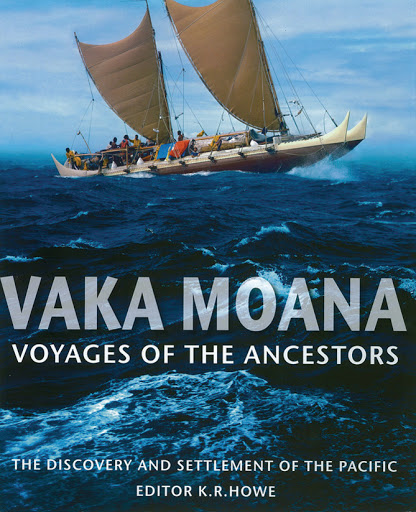 Last but not at all least, the final book review in my books of the sea roundup–one sure to become a local shelves staple.
Vaka Moana, Voyages of the Ancestors: The Discovery and Settlement of the Pacific
Edited by K. R. Howe
UH Press; 360 pages; $59Reviewed by Christine Thomas Special to the Honolulu Advertiser
Much the same way crewmembers work together to sail a voyaging canoe, fourteen authors worked with Massey University professor and editor K. R. Howe to form the five-pound tome “Vaka Moana,” a compilation of scholarly but accessible essays on the epic history of Pacific settlement. Swollen with 400 color and black and white illustrations, including beautiful photographs, artifacts, maps, and charts, each storyteller’s personalized prose conveys the most current knowledge about voyaging past and present.
Pacific voyagers left the sight of land thousands of years before any other explorers, and settled the last places on Earth. Thus the authors appropriately cover a broad range of topics—human evolution, Polynesian traditions, voyaging (including a subsection on Nainoa Thompson), life and trade after exploration, and Western ideas about origins—amounting to a piercing encyclopedic examination of our Pacific ancestors’ daring journey, and mirroring the prominence of indigenous nationalism today.
As the book notes, “Pacific people know their stories. But the world does not.” This complete and thorough work aims to change that, and any misperceptions about the world’s first maritime people. It’s sure to become a staple on local shelves, as much as “Shoal of Time” or the “Loyal to the Land” series.

 This interview with artist Pegge Hopper originally appeared in the Honolulu Advertiser in December, 2006. Our conversation was among the best I’ve had in thirteen months of writing this column. On a side note, Hopper recently illustrated a charming children’s book called A Clever Dog.
What I’m Reading | Pegge Hopper
ArtistQ&A with Christine Thomas
–What are you reading?
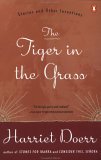
I’m addicted to the New Yorker; when it comes I drop everything. That, American Prospect, Harper’s and the Atlantic Monthly are my favorite magazines. When I was in Mexico last month I read “The Book ofSalt” by Monique Truong, and I love Harriet Doerr. The last book of hers I finished was a collection of short stories called “The Tiger in the Grass: Stories and Other Inventions.” She has written beautifully and sensitively about Mexico.
–What do you like about it?
It’s mostly her sensitivity to details. “The Book of Salt” was interesting and you were very conscious of the writing—for me the writing overpowered the story. But with Durer you’re so wrapped up in her sensitive descriptions and the story she’s telling that it almost transports you to the place.
–Is Durer also captivating because you, too, focus on delicate elements of composition to transport viewers to a fictional, painted world?
You may be right. There’s a gentleness about Durer, but underneath that gentleness there’s a really strong spine. She writes from strength but the things she notices about life are very gentle and sensitive and beautiful. I don’t consider myself to be literary—I guess I just want to be transported, not necessarily challenged. I really do love beauty. I used to balk at being called a decorative artist, but now I don’t care. There’s nothing wrong with loving beauty.

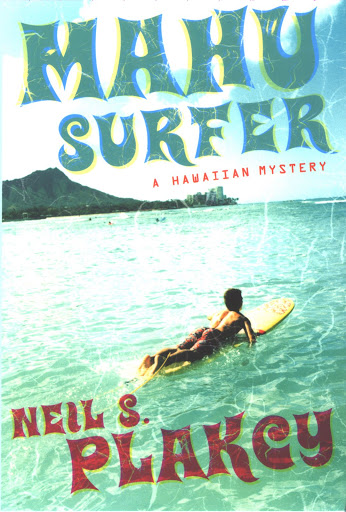 Part two of the roundup of books of the sea, a flawed but enjoyable mystery.
Mahu Surfer: A Hawaiian Mystery
By Neil S. Plakcy
Alyson Books; 314 pages; $14.95
Reviewed by Christine Thomas Special to the Honolulu Advertiser
The message is ‘out’ from the title of Plakcy’s second novel, which follows thirty-two year-old Kimo Kanapa`aka, a recently outed homosexual Honolulu Police detective, as he goes undercover to solve the murder of three North Shore surfers. A Florida resident with an abiding interest in Hawai`i, Plakcy undertakes a significant risk not only in writing about the Islands, but via a first person, Native Hawaiian voice—one that in this case was better left alone.
For while the mystery has spotless pace, intriguing plots twists, and an earnest depiction of the real challenges faced by people transitioning out of the closet, Kimo narrates like he’s explaining Hawai`i to unknowing readers and it’s impossible to ignore the myriad errors that threaten to overwhelm the story. There are small spelling mistakes, such as Hawaiian spelled “Hawai’ian” and every ‘okina rendered as an apostrophe, and medium characterization flaws such as Kimo’s affinity for Tevas, the mark of tourists. Worse are glaring mistakes, such as a large landowner character, conspicuously named Bishop, owning a stretch of beach, or painting the North Shore and Honolulu as distant communities, where North Shore residents aren’t able to see Honolulu’s newscasts.
Had the protagonist been a malihini instead, errors could be built into the plot and add depth to the story of a likeable, altruistic detective, showing off Plakcy’s capable storytelling skills instead of a lack of thorough research about setting and culture.




 Literary Lotus