
Embedded from Infographics Only
Categories: Musings
Embedded from Infographics Only
As the roosters crowed and the December sun poked through Kona’s celebrated puffy white clouds, my roommate awakened me: “It’s clear! Let’s go before everyone on the island is at the top of Mauna Kea.” After a few days of unusually copious snowfall atop the world’s tallest volcano, we—like others ready to take on the reduced atmospheric pressure at its nearly 14,000-foot height—had been awaiting the perfect day to drive to the summit and revel in Hawai‘i’s rarest activity: playing in the snow.
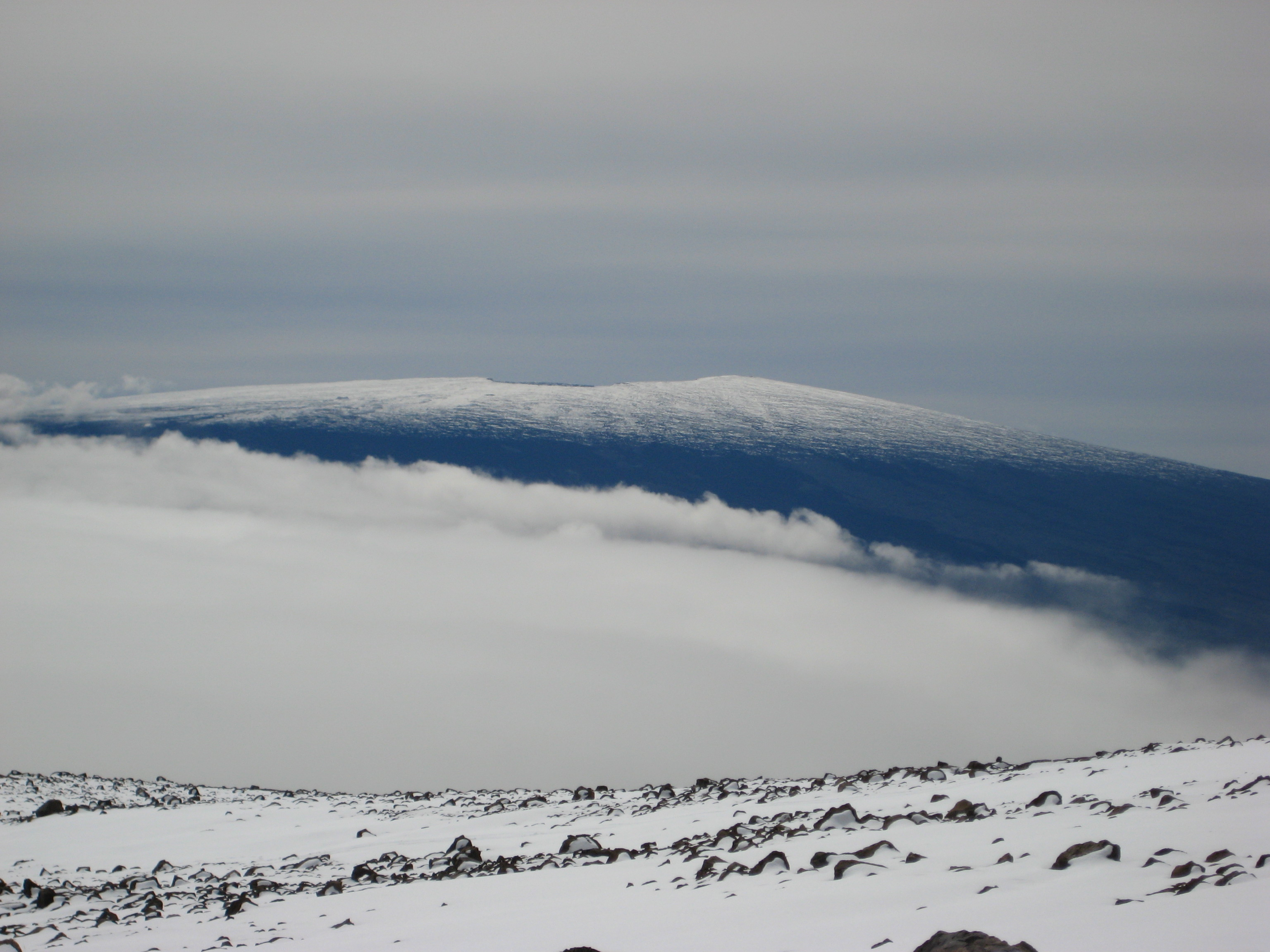
View of snowcapped Mauna Loa from the road to Mauna Kea
The snow report confirmed that the summit road was open, so after packing gear and sandwiches, our quartet set off in a four-wheel-drive Jimmy toward the infamously bumpy and weaving Saddle Road. Ours was one of few cars along this 6,600-foot elevation shortcut between Hawai‘i Island’s Kona and Hilo shores, which straddles the valley between the homes of two rival Hawaiian goddesses: Poli‘ahu, whose icy cloak rests on Mauna Kea’s wintry slopes, and Pele, who sometimes alights inside the more fiery volcano Mauna Loa. As we drove past mossy pastureland and then brittle ‘ōhi‘a forests, Mauna Loa’s rounded, snow-dusted peaks beckoned, while Mauna Kea’s spiny profile practically dared us to ascend.
About an hour later, we turned onto Mauna Kea Access Road, easily scaled on a paved slope laid down amid barren rock. Yet even this unforgiving landscape houses hearty flora and fauna. We spotted endangered silversword, māmane trees, diminutive francolins, and endemic ‘ōhelo shrubs and berries, a favorite treat of the nēnē. Just 20 minutes after that, we arrived at the Visitor Information Station and stepped into the brisk air at 9,300 feet.
The station’s website recommended at least a 30-minute stop to acclimate to the high altitude before going up. Visitors without a 4WD vehicle shouldn’t go farther, but that doesn’t mean there’s nothing to see. We looked at the interactive displays and watched a film about Mauna Kea. The website has more information about hiking and nightly public stargazing.
 We were eager to arrive at the top before the crowds and afternoon clouds, and after donning warmer layers, we soon began the slow drive up the steep and gravelly summit road. During the eight-mile journey, there was plenty of time to photograph breathtaking views around each switchback. At 12,000 feet, a thick blanket of snow covered the site of an ancient Hawaiian adz quarry—the largest primitive quarry in the world—and its ancient heiau, petroglyphs, and hiking trails. From then on, all was white until we began to see parked cars lining the roadside, and we stopped near shiny silver observatory domes bathed in potent sunlight.
 My fingers burned with cold and my head ached as if I’d worn a too-small hat, but the island’s highest 360-degree view provided an arresting distraction. Visibility was so clear. I peered down to lush green Waimea pastures, out across a broad moonscape of cinder cones, and across the sea to Maui’s Haleakalā. As we unloaded our sleds and snowboards, watching others throw snowballs or pile snow into truck beds to bring home, I marveled at this otherworldly place. It resounded with an almost tangible spiritual presence that commanded respect, yet it was still so close to home.
Hawaiians believe heaven and earth connect on the summit of Mauna Kea. Standing tall on its snowy peaks that day, it was easy to understand why.
By Christine Thomas
for AAA Hawai‘i Magazine
LL
What’s the catch? Perhaps that is the question Susan Lindley, the damaged but easily likeable protagonist of , should have asked when she inherited her distant uncle’s massive Pasadena estate. In her case, the catch isn’t taxes or finances but taxidermy — the house is packed with preserved specimens, from quail to lion.
Yet while Susan at first intends to donate them, the specimens soon become a strange comfort while at the same time deepening into a symbolic narrative touchstone. “At first she had been determined to rid herself of their carcasses with all possible speed, but curiously the impulse was fading: the longer she lived with them the greater their hold.” Soon Susan even begins to feel protective of those in need of repair. The creatures become a constant reminder of one of the novel’s premier concerns — death, loss and survival, both animal and human.
 But let’s rewind. Lydia Millet’s nuanced and thoughtful book — the third in a series that began with 2008’s How the Dead Dream, followed by last year’s Ghost Lights — is not just about this curious plot element. The novel opens with Susan’s cutting ruminations on the nature of man, specifically how hormones make men and women insane: “Oddly, the chronic insanity of men was often referred to as stability; the men, being permanent sociopaths, got credit for consistency. Whereas women, being mere part-time neurotics, were typecast as flighty.”
The passage signals readers that the book is foremost one of ideas, and it situates Susan wittily inside her struggle with sexual transgressions and desires. Soon afterward, she and her daughter Casey are faced with the murder of her husband, Hal, who has been living in Belize since he discovered Susan’s infidelity (his journey is detailed in Ghost Lights; How the Dead Dream introduces Susan’s employer T and his growing obsession with disappearing species). Rather than consuming all the narrative tension at the start, the setup is an effective launching pad for a novel that is also about much more than how Susan and Casey navigate the aftermath of Hal’s death.
Flesh and skin bind the narrative, which is entwined with Susan’s concerns. When letting go of Hal, she remembers his skin: “It was the skin that bound you most, the contact of two skins.” And of course in her sexual liaisons, she needed the contact of flesh, not the meeting of minds. “Flesh was always a consolation — flesh, not beauty.” But Millet’s prose is most charged by its probing yet subtle exploration of the meaning of existence and the visceral experience of love and loss.
Everything dies, Millet seems to assert, so what are we making so much fuss about? Or are we making too little? Through Susan, wry humor seeps into intrepid investigations into death and dying: “In any case the dead were almost as beautiful as the living, sometimes more so. They had far fewer needs.”
When a twist brings T.’s aging mother to stay at her home, Susan is slowly surrounded by aging and dead things — elderly ladies who lunch and long-dead animals, while she’s only getting older each day: “We’re brittle and fading, she thought. Fading like moths, gray-blond mothers. With each day the population aged.”
There’s much to explore in Magnificence, which is ambitious, often funny and deliciously provocative. One needn’t have read the entire series to be consumed by its pleasures, but by the time you reach its beautiful end, considerable comfort lies in the existence of two more novels in which to delight in Millet’s writing and imagination.
Read more here. LL
It’s not surprising that I think books make great gifts, though I am an impossible person to buy books for. That makes the upcoming Downtown Holiday Book Fair on December 12 from 11-2 a must-attend.
 A slew of local publishers will be in front of 24-Hour Fitness and Territorial Savings at the corner of King and Bishop Streets in Downtown Honolulu so that you can shop direct from their latest and greatest titles.
Look for Watermark Publishing (publisher of Don’t Look Back), Bamboo Ridge Press, University of Hawai‘i Press, Bess Press, Kamehameha Publishing, Island Paradise Publishing, Slate Ridge Press, and Belknap Publishing.
Publishers’ most popular titles, special gift items and great deals will be on offer. Come on down!
I love these quotes about why books make great gifts, so you don’t have to take my word for it:
“Books make great gifts because they have whole worlds inside them, and it’s much cheaper to buy somebody a book than it is to buy them the whole world.” –Neil Gaiman
“Books make great gifts because… [they don’t] come in any particular size, so you don’t have to be embarrassed if you bought somebody the wrong size.” –Valerie Bertinelli
“Books make great gifts because they’re something you love that you can share.” –John Lithgow
“[Books are] the most fun you can have for under $25. You and your significant other can’t go to a movie and buy popcorn and have that much fun!” –Al Roker
“Books make great gifts because you don’t have to plug them in.” –Alec Baldwin
(Source: http://www.booksaregreatgifts.com/)
LL
 Literary Lotus